


The use of LED lighting is on the rise. In significant numbers, LED goods and alternatives to standard incandescent and compact fluorescent (CFL) energy-efficient bulbs are already available in the market.
Even though many LED goods look like regular light bulbs or fluorescent tubes and employ a newer technology that has been in use for decades, the conversion to residential LED lighting can be challenging. When shopping for LED items, it’s essential to know the “must-know” phrases, and this article explains what those terms are and how to use them to your advantage.
Table of Contents
Why Switch From Incandescent To LED?
In addition to being significantly more power-efficient than standard and CFL options, they will last longer, don’t contain mercury like CFLs, and offer a much more comprehensive range of brightness and light look possibilities than CFLs (warm vs cool). LEDs are also available in various shapes other than the standard light bulb. Because of their small size, LED lighting fixtures are available in a wide variety of shapes, sizes, and colours, allowing for an almost limitless number of ways to employ and incorporate light into a home.
The Right Lighting For Different Lighting Functions And Regions In Your Home
Illumination’s Various Purposes
The most common types are ambient, job, accent, and decorative lighting. Distinct categories serve different functions. When designing a home’s lighting, it’s helpful to know how the various light levels work together.
Atmospheric Light
For emerging and orientation, ambient (or overall) light distributes a consistent amount of sunlight across the space. Examples of ambient lighting are recessed downlights, cove lighting, and hanging fixtures.
Lighting for Tasks:
A reading light or a make-up mirror can illuminate a workspace, such as a kitchen countertop. This light draws attention to a specific region when used with ambient lighting.
Lighting for Accents:
It’s used to draw attention to artwork, architectural details, or flora by varying the object’s brightness. Adjustable fixtures, track lighting, wall washing, and grazing are common ways to generate this effect.
Lights for the Home and Office
Decorative lighting fixtures serve primarily as eye-catching ornaments for the home. Typical examples include chandeliers and wall sconces.
This kind of lighting layering is beneficial in creating a relaxing and visually balanced environment.
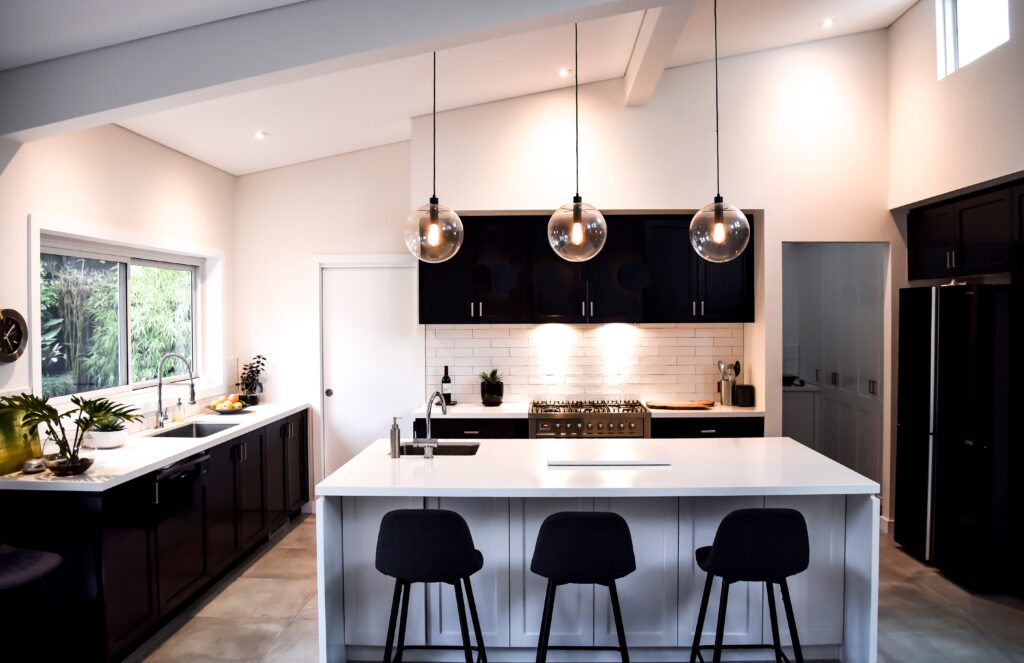

It’s time to consider the colour temperature after deciding on the sort of light fixture that will be used for each function.
Choosing The Proper Lighting For Your Home Is A Critical Design Process.
A light’s colour temperature is a matter of personal preference, but a few criteria may be proposed to help in the selection process.
Light Colour Temperatures in the Environment
An important aspect of a room’s mood and ambience is its ambient lighting, the primary source of light in the space.
- Warm white lighting is frequently used in living bedrooms for a homey feel.
- Residential LED lighting commonly has Kelvin ratings of 2700K and 3000K. Lights in warm white are an excellent match for wood and earthy tones.
- Choosing the same colour temperature for downlights or cove lighting, for example, can create a uniform, harmonious impact if more than one type of artificial light is placed.
- Warm white is popular, but rooms with light furnishings and crisper colours such as white or blue, for example, can benefit from the more neutral light colder than the warm white most people prefer.
- Neutral white lighting has kelvin levels from 3500 to 4000, which is believed to be brighter and better accentuates lighter colours.
- Research has shown that neutral and cold white light has had an energetic effect on humans, making it an excellent choice for homes, offices, and study rooms.
- Choosing neutral or cool white light for the bathroom’s leading ambient light is brilliant because it generates a contrast ratio to warm white.
Task Lighting Colour Temperatures
When performing a visual job, task lighting provides a brighter light source than the ambient environment. To obtain adequate contrast, the light should be neutral to warm white in the range of 3500K to 5000K. In addition to colour temperature, the CRI and brightness of task lighting are critical.